Good news: a metric tape measure is easier to read than an imperial one. There are no fractions to count or simplify. Every small line is one millimeter, every numbered line is one centimeter, and 100 centimeters make a meter. If you can count to ten, you can read a metric tape.
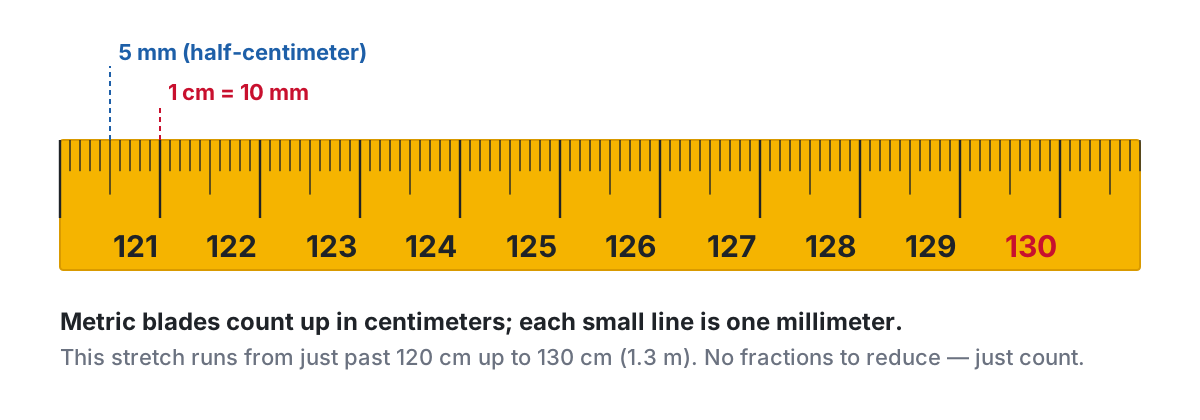
The three units on a metric blade
| Unit | Symbol | How it looks on the blade | Size |
|---|---|---|---|
| Millimeter | mm | Shortest line | 1/10 of a centimeter |
| Half-centimeter | — | Medium line halfway between numbers | 5 mm |
| Centimeter | cm | Long line with a printed number | 10 mm |
| Meter | m | Usually flagged in red, or labeled “1M”, “2M” | 100 cm = 1,000 mm |
How to read a metric tape in three steps
Read the last numbered line
Find the last centimeter number before your mark. If your mark is between 47 and 48, you have 47 centimeters.
Count the millimeter lines past it
Count the small lines from that number to your mark. The medium line in the middle is 5 mm, so count from there if your mark is past it. Seven lines past 47 is 47 cm 7 mm.
Write it in one unit
Combine the two into a single unit: 47 cm 7 mm is 47.7 cm or 477 mm. Builders and engineers usually work in millimeters to avoid decimal points altogether.
Reading past one meter
Most metric tapes keep counting centimeters past 100: 101, 102, 103 and so on. Some show the meter number with smaller centimeter numbers, such as “1m 20” or a small “1” before “20”. Both mean 120 cm, or 1.20 m. The 130 printed in red in the diagram above shows a common way of highlighting every 10 centimeters.
Examples:
- Last number 182, then 4 small lines → 182.4 cm = 1,824 mm = 1.824 m
- Last number 63, mark on the medium line → 63.5 cm = 635 mm
- Last number 9, then 9 small lines → 9.9 cm = 99 mm (just shy of 10 cm)
Dual-scale tapes (inches and centimeters)
Many tapes sold in North America print inches along the top edge and metric along the bottom. They are handy, but they cause one common mistake: reading the number from one edge and the small lines from the other. To avoid it:
- Decide which unit you need before you look at the blade.
- Cover the edge you are not using with your thumb if it helps.
- Check that your answer makes sense: a kitchen counter is about 36 inches tall, or about 91 cm. If you get 36 cm, you read the wrong scale.
Converting between metric and inches
The inch is defined as exactly 25.4 millimeters, so conversions are exact as long as you round only at the end.
| To convert | Do this | Example |
|---|---|---|
| Inches → millimeters | Multiply by 25.4 | 8 in × 25.4 = 203.2 mm |
| Millimeters → inches | Divide by 25.4 | 300 mm ÷ 25.4 ≈ 11.81 in |
| Inches → centimeters | Multiply by 2.54 | 36 in × 2.54 = 91.44 cm |
| Centimeters → inches | Divide by 2.54 | 50 cm ÷ 2.54 ≈ 19.69 in |
| Feet → meters | Multiply by 0.3048 | 10 ft × 0.3048 = 3.048 m |
To turn a decimal inch result into something you can find on an imperial tape, multiply the decimal part by 16 and round. 11.81 in → 0.81 × 16 ≈ 13, so 300 mm is about 11 13/16 in. The fractions chart lists every sixteenth with its millimeter value.
Handy metric reference sizes
Having a few real-world sizes in your head helps you catch reading mistakes.
- A standard credit card is about 85.6 mm × 54 mm.
- A sheet of A4 paper is 210 mm × 297 mm.
- An interior door in many countries is about 2 meters tall.
- The width of a typical adult fingernail is roughly 1 cm.
Practice
Last number 54, then 3 small lines
54.3 cm = 543 mm
Last number 211, mark on the medium line
211.5 cm = 2,115 mm = 2.115 m
Convert 1,200 mm to inches
1,200 ÷ 25.4 ≈ 47.24 in ≈ 47 1/4 in
Convert 15 3/4 in to mm
15.75 × 25.4 = 400.05 mm
Working mainly in inches? Go back to the step-by-step imperial guide.