How do I read a measuring tape?
Find the last whole inch, count the small lines past it, and turn that count into a fraction. That is the whole skill. The guides on this site walk you through each part with diagrams, worked examples and practice questions, so you can read any tape measure quickly and get it right the first time.
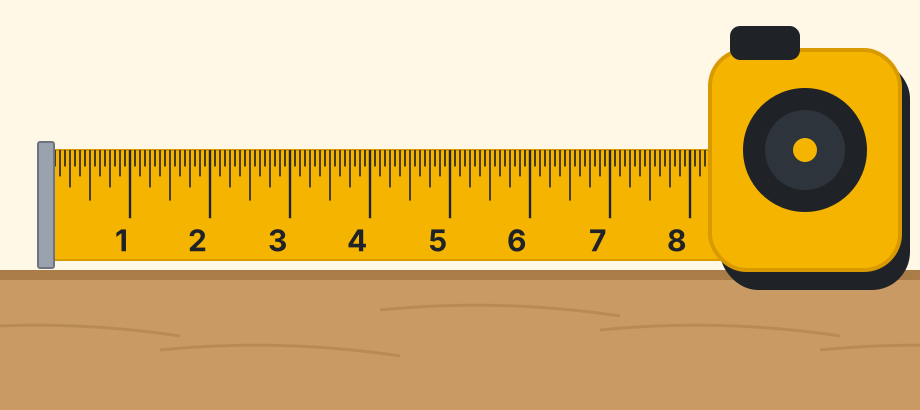
Reading a tape measure in four moves
Most tape measures sold in the United States divide every inch into 16 equal spaces. Once you know that, every line on the blade has a predictable meaning.
Find the last whole inch
Look at the large printed number just before the spot you are measuring. That number is your whole inches. If the blade also shows feet, note those too, because 2 ft 3 in is 27 inches, not 23.
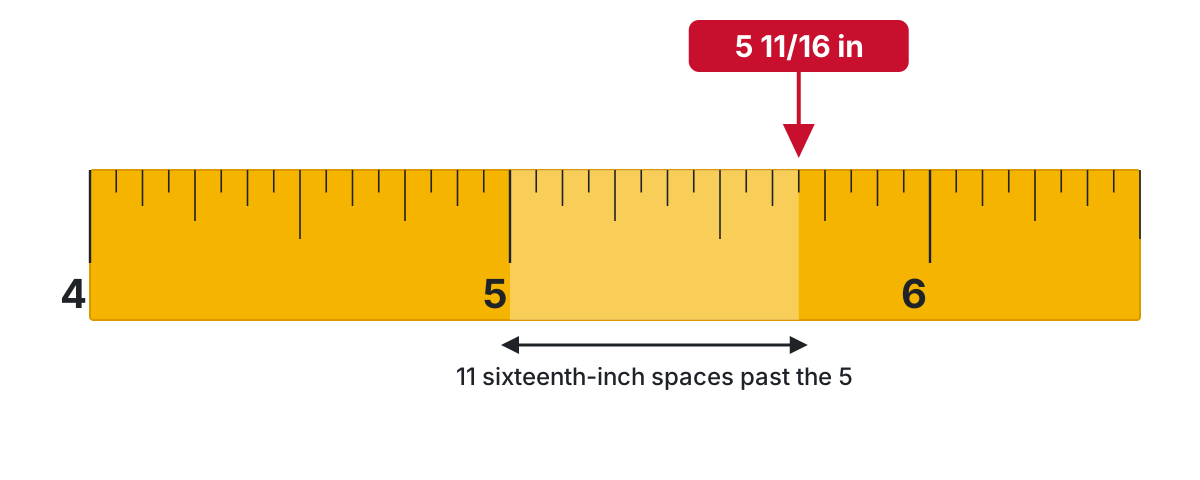
Count the small lines past it
Count each line after that inch number, up to your mark. Each step is one sixteenth of an inch. Eleven lines past the 5 means 5 and 11/16 inches.
Reduce the fraction if you can
An even count can be simplified: 8/16 is 1/2, 4/16 is 1/4, 6/16 is 3/8. An odd count, such as 11/16, is already as simple as it gets.
Say it out loud, then write it down
“Five and eleven-sixteenths.” Saying the full measurement before you write it is the easiest way to catch a slip such as reading the wrong inch number.
Need more detail? The full step-by-step guide covers hooking the blade, reading feet and inches, and measuring inside spaces.
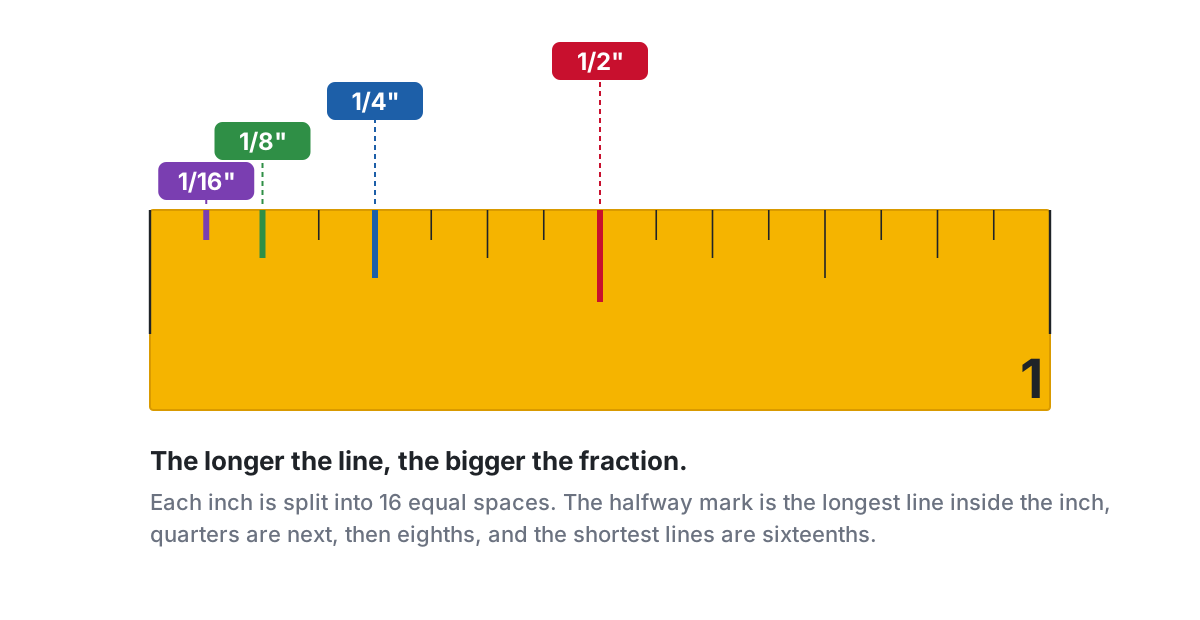
The line length tells you the fraction
Tape makers draw the lines in a hierarchy so your eye can find them fast. The inch line is the longest. Inside each inch, the half-inch line is next longest, followed by the quarter-inch lines, then eighths, then sixteenths.
That means you rarely need to count all sixteen spaces. If your mark lands on the longest line inside the inch, it is a half. If it lands on the next size down, it is either 1/4 or 3/4. Counting is only needed for the shortest lines.
Pick the guide that fits your question
Each guide stands on its own, so you can jump straight to the part that is tripping you up.
Step-by-step guide
From hooking the blade to writing down the final number, with worked examples.
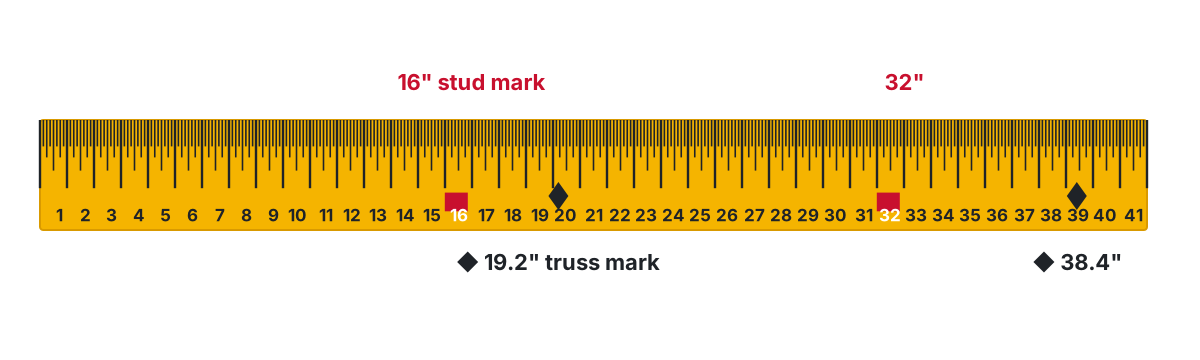
Markings explained
Red boxes, black diamonds, foot markers, the loose hook and the number on the case.
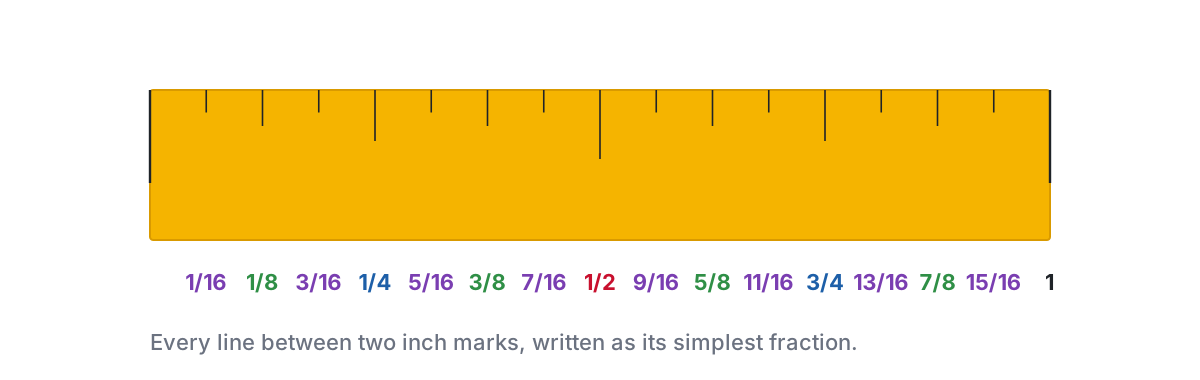
Fractions chart
All sixteen fractions with decimals and millimeters, plus how to add and halve them.
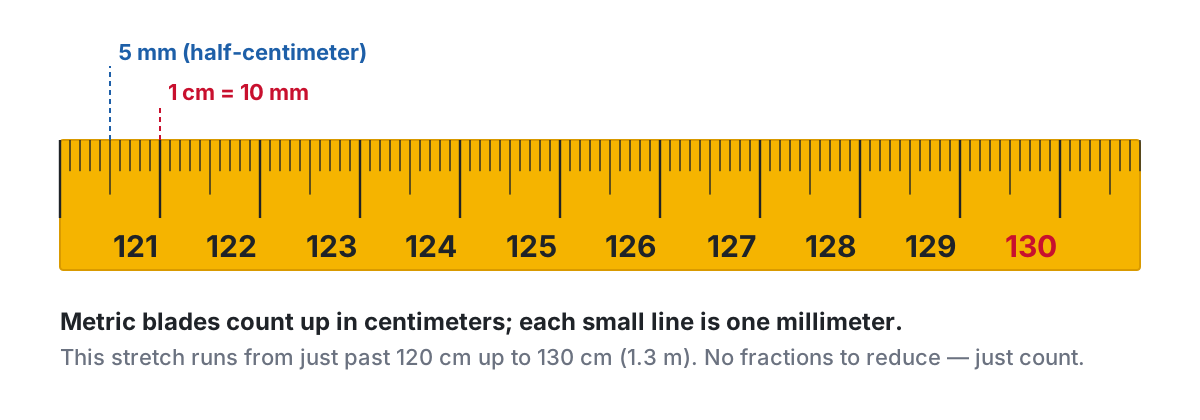
Metric tapes
Millimeters, centimeters, meters and dual-scale blades — no fractions required.
Five facts that make every reading easier
Can you read these?
Try each one before you open the answer. If any trip you up, the step-by-step guide explains exactly why.
7 inches + 4 small lines
4/16 reduces to 7 1/4 in.
2 inches + 13 small lines
13 is odd, so it stays 2 13/16 in.
The longest line between 9 and 10
That is the half-inch line: 9 1/2 in.
Blade reads 3F 2 in
3 × 12 + 2 = 38 in.
Frequently asked questions
Why is the metal hook on the end loose?
It is supposed to move. The hook slides a distance equal to its own thickness, so the reading is accurate whether you hook it over an edge or push it against a wall. Bending the hook to “fix” the wobble ruins that accuracy. The markings guide shows how it works.
Do all tape measures use sixteenths?
Most general-purpose imperial tapes use sixteenths. Some finer tapes mark 1/32 of an inch along the first 12 inches or so for detailed work. Metric tapes use millimeters instead of fractions.
What is the quickest way to get faster?
Learn to spot the half, quarter and eighth lines by their length, and only count when your mark lands on a short sixteenth line. Practice by measuring ten objects around the house and checking each with the fractions chart.
Is a tape measure accurate enough for woodworking?
For most projects, yes, as long as you use the same tape for every cut. Two different tapes can disagree slightly, so pick one and stick with it for the whole job.