A tape measure gives you fractions, but plans, cut lists, calculators and CNC tools often want decimals or millimeters. This page gives you every sixteenth of an inch in all three forms, plus simple methods for adding, subtracting and halving tape measurements without a calculator.
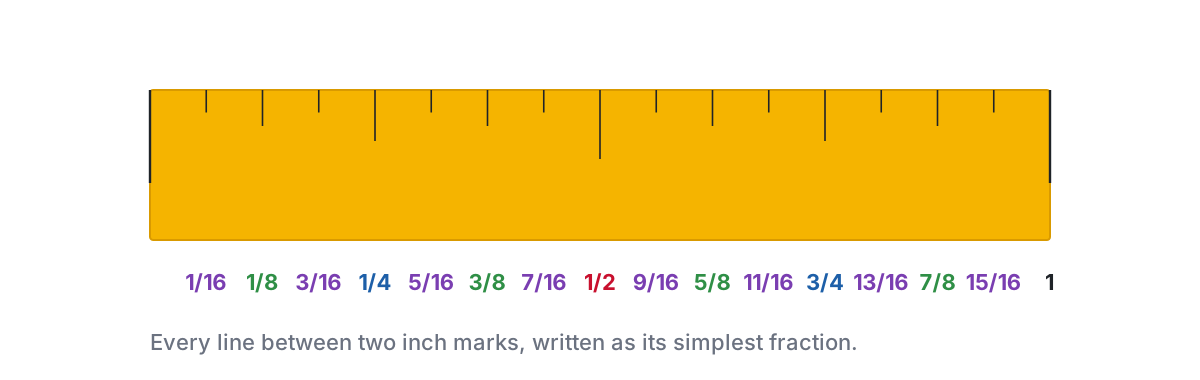
Tape measure fractions chart: sixteenths
Use the first column if you counted lines, the second for how the measurement is normally written, and the last two for conversions. Millimeter values are rounded to two decimal places. One inch equals exactly 25.4 mm.
| Lines counted | Fraction | Decimal inch | Millimeters |
|---|---|---|---|
| 1/16 | 1/16 | 0.0625 | 1.59 |
| 2/16 | 1/8 | 0.1250 | 3.18 |
| 3/16 | 3/16 | 0.1875 | 4.76 |
| 4/16 | 1/4 | 0.2500 | 6.35 |
| 5/16 | 5/16 | 0.3125 | 7.94 |
| 6/16 | 3/8 | 0.3750 | 9.53 |
| 7/16 | 7/16 | 0.4375 | 11.11 |
| 8/16 | 1/2 | 0.5000 | 12.70 |
| 9/16 | 9/16 | 0.5625 | 14.29 |
| 10/16 | 5/8 | 0.6250 | 15.88 |
| 11/16 | 11/16 | 0.6875 | 17.46 |
| 12/16 | 3/4 | 0.7500 | 19.05 |
| 13/16 | 13/16 | 0.8125 | 20.64 |
| 14/16 | 7/8 | 0.8750 | 22.23 |
| 15/16 | 15/16 | 0.9375 | 23.81 |
| 16/16 | 1 | 1.0000 | 25.40 |
Thirty-seconds (odd values)
Finer tapes and steel rules sometimes mark 1/32 inch. Even thirty-seconds simplify to sixteenths (for example 6/32 = 3/16), so only the odd values are listed here.
| Fraction | Decimal inch | Millimeters |
|---|---|---|
| 1/32 | 0.03125 | 0.79 |
| 3/32 | 0.09375 | 2.38 |
| 5/32 | 0.15625 | 3.97 |
| 7/32 | 0.21875 | 5.56 |
| 9/32 | 0.28125 | 7.14 |
| 11/32 | 0.34375 | 8.73 |
| 13/32 | 0.40625 | 10.32 |
| 15/32 | 0.46875 | 11.91 |
| 17/32 | 0.53125 | 13.49 |
| 19/32 | 0.59375 | 15.08 |
| 21/32 | 0.65625 | 16.67 |
| 23/32 | 0.71875 | 18.26 |
| 25/32 | 0.78125 | 19.84 |
| 27/32 | 0.84375 | 21.43 |
| 29/32 | 0.90625 | 23.02 |
| 31/32 | 0.96875 | 24.61 |
How to simplify a tape fraction
Write the count over 16, then divide the top and bottom by 2 for as long as the top number stays even.
- 14/16 → 7/8
- 12/16 → 6/8 → 3/4
- 4/16 → 2/8 → 1/4
- 9/16 → stays 9/16 (odd top number)
Adding two measurements
Convert both fractions to sixteenths
Example: 3 3/8 in + 2 5/16 in. 3/8 is 6/16, so you are adding 3 6/16 and 2 5/16.
Add whole numbers and sixteenths separately
3 + 2 = 5. 6 + 5 = 11 sixteenths. Result: 5 11/16 in.
Carry over if you pass 16
If the sixteenths add up to 16 or more, subtract 16 and add 1 to the whole inches. 4 12/16 + 1 9/16 = 5 21/16 = 6 5/16 in.
Subtracting a saw kerf or a measurement
Subtraction works the same way. If the top fraction is smaller, borrow 16 sixteenths from the whole inches. Example: 10 1/8 in − 3/16 in. 1/8 is 2/16, which is smaller than 3/16, so borrow: 10 2/16 becomes 9 18/16. Then 9 18/16 − 3/16 = 9 15/16 in.
This is useful when you need to take the thickness of a saw blade into account. Many common circular saw and table saw blades remove about 1/8 inch of material per cut, though thin-kerf blades remove less; check your blade’s specifications.
Finding the center of a board
To halve a measurement, halve the whole inches and the sixteenths separately. If the whole number is odd, turn the leftover inch into 16 sixteenths first.
- Half of 24 3/4 in: 3/4 = 12/16. Half of 24 is 12, half of 12/16 is 6/16. Center = 12 3/8 in.
- Half of 31 1/2 in: 31 is odd, so write 30 + 1 8/16 = 30 24/16. Half is 15 12/16 = 15 3/4 in.
- Half of 9 5/16 in: 9 5/16 = 8 21/16. Half of 8 is 4; half of 21/16 is 10.5/16. That falls between two sixteenth lines, so mark at 4 21/32 in, or split the difference between 4 5/8 and 4 11/16 by eye.
Quick decimal-to-tape conversion
Going the other way — from a decimal on a plan to a line on your tape — multiply the decimal part by 16 and round to the nearest whole number. That is how many sixteenths to count.
- 0.3 in × 16 = 4.8 → about 5/16 in
- 0.72 in × 16 = 11.52 → about 12/16 = 3/4 in
- 0.9 in × 16 = 14.4 → about 14/16 = 7/8 in
For millimeters, divide by 25.4 to get inches first. 100 mm ÷ 25.4 = 3.937 in; 0.937 × 16 ≈ 15, so 100 mm is about 3 15/16 in.
Practice
Write 11/16 as a decimal
0.6875
2 7/8 in + 1 3/8 in
2 14/16 + 1 6/16 = 3 20/16 = 4 1/4 in
Center of a 46 5/8 in shelf
46 10/16 ÷ 2 = 23 5/16 in
How many sixteenths is 0.45 in?
0.45 × 16 = 7.2 → about 7/16 in
New to reading fractions on the blade itself? Start with the step-by-step guide, then come back here to convert.